
Events
Check out our calendar of events and participate in our seminars, public lectures and more.
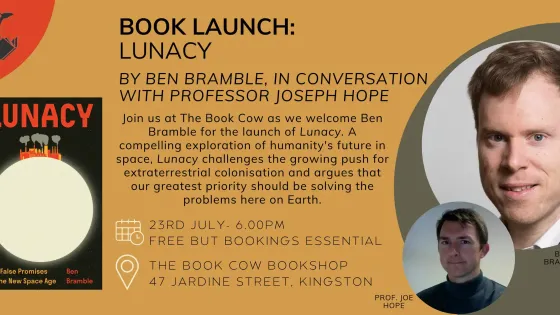
Join Fenner Ben Bramble at The Book Cow for the launch of his latest book Lunacy. A compelling exploration of humanity's future in space, Lunacy challenges the growing push for extraterrestrial colonisation and argues that our greatest priority should be solving the problems here on Earth.

Buildings are both a major contributor to climate change and highly vulnerable to its impacts. This seminar explores the relationship between buildings and climate change, focusing on energy use, material demand, carbon emissions, and climate-related risks. The talk will discuss how the building sector can contribute to mitigation and adaptation, and highlight pathways towards more sustainable, resilient, and low-carbon-built environments.
Past events

This talk examines how heatwaves alter wind power output across the National Electricity Market, using high-resolution climate reanalysis and dispatch timeseries.

ANU Fenner School of Environment & Society research students are presenting their work in two days of talks
ANU Fenner School of Environment & Society research students are presenting their work in two days of talks

Come along and support our Fenner Honours and Masters students and hear about all the exciting research taking place at the Fenner School.


This seminar explores how leading cities are accelerating decarbonisation by supporting others. It examines why cities act as influencers, the conditions that enable this, and the broader impacts on urban sustainability transitions.

Find out what an Honours/Masters research year involves at the ANU Fenner School of Environment and Society.

This talk explores why current hydrologic models may underestimate future water risks. It highlights the need to better represent vegetation, soils, evapotranspiration, and uncertainty to improve climate adaptation and water planning.

This talk presents an ARC project supporting the re-emergence of cultural burning in box-gum woodlands. Grounded in partnerships with First Nations communities, it explores how Indigenous-led practices can restore ecosystems and strengthen culture.